Growth performance and physiological responses of Physa acuta fed on Lemna minor Under Laboratory Conditions
Keywords:
Food Consumption, Growth, Laboratory Experiments, Lemna Minor, Physa AcutaAbstract
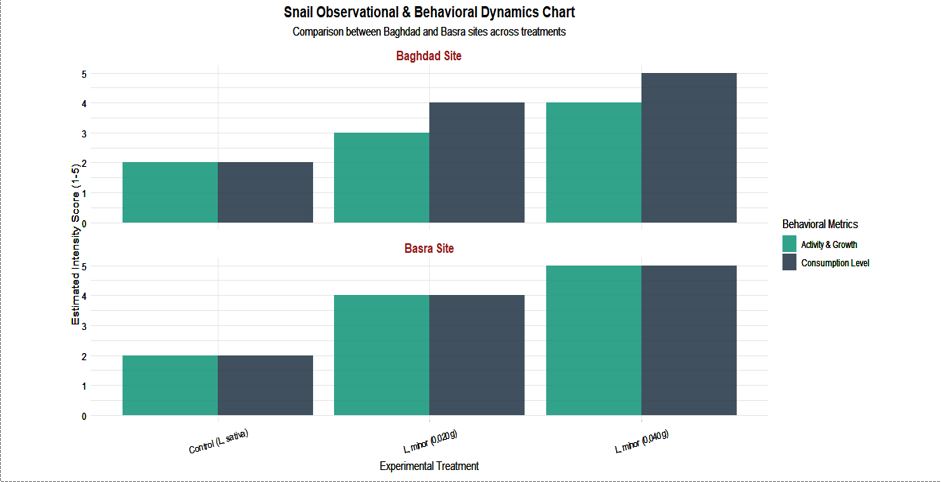
The study aimed to evaluate the effect of feeding snails on the plant Lemna minor on growth and food consumption indicators of the snail Physa acuta, comparing the responses of two groups of snails collected different sites from of Baghdad and Basra. The nutritional treatments included a control treatment using lettuce and two treatments with Lemna minor at levels of 0.020 and 0.040 g. Growth indicators, daily food consumption rate and behavioural and vital observations within the tanks. The results showed significant differences between the nutritional treatments in growth and food consumption indicators, as the addition of Lemna minor led to gradual improvement in snail performance compared to the control treatment. A level of 0.040 g recorded the highest values for the rate of increase in length, reaching 2.12 and 3.88 mm in Baghdad and Basra, respectively. Moreover, the highest rate of increase in weight was 0.0263 and 0.0393 g , in addition to the highest specific growth rates for length and weight. The same level also recorded the highest daily food consumption rate, reaching 3.84 and 4.12 mg dry weight/snail/day in Baghdad and Basra, respectively. The snails from Basra showed relatively higher values for most growth and consumption indicators compared to the snails from Baghdad, especially at the level of 0.040 g. The results indicate that increased availability of Lemna minor at the tested levels was associated with improved food consumption and growth performance of P. acuta, with the 0.040 g level being the best among the studied treatments. These results support the potential use of L. minor as a plant-based food source in studies on the breeding and growth of Physa acuta under experimental conditions.
References
Achoki, J. K.; Kaingu, C. K.; Oduma, J. A.; Orina, P. S.; Ondiba, R. N.; Nyabwanga, R. N.; & Getabu, A. M. (2024). Does duckweed (Lemna minor) feed inclusion play a role on growth, feed conversion ratio and reproductive performance (fertilization, hatchability and survivability rates) in omnivorous fish? Evidence in Nile tilapia (Oreochromis niloticus‐Linnaeus, 1758). Aquaculture, Fish and Fisheries, 4(4):1-12, e70000. https://doi.org/10.1002/aff2.70000
Ali, M. H.; Mohammed, H. H., & Ahmed, H. K. (2020). Temperature impacts on the cardiac activity of the Snail Pomacea canaliculata from Shatt Al-Arab Region, Basrah, Iraq. Baghdad Science Journal, 17(2):436-443. https://doi.org/10.21123/bsj.2020.17.2.0437
Auld, J. R., & Henkel, J. F. (2014). Diet alters delayed selfing, inbreeding depression, and reproductive senescence in a freshwater snail. Ecology and Evolution, 4(14): 2968-2977. https://doi.org/10.1002/ece3.1146
Bousset, L.; Henry, P. Y.; Sourrouille, P., & Jarne, P. (2004). Population biology of the invasive freshwater snail Physa acuta approached through genetic markers, ecological characterization and demography. Molecular Ecology, 13(7): 2023-2036. https://doi.org/10.1111/j.1365-294X.2004.02200.x
Ceschin, S.; Crescenzi, M., & Iannelli, M. A. (2020). Phytoremediation potential of the duckweeds Lemna minuta and Lemna minor to remove nutrients from treated waters. Environmental Science and Pollution Research, 27(13): 15806–15814. https://doi.org/10.1007/s11356-020-08045-3
Chakrabarti, R.; Clark, W. D.; Sharma, J. G.; Goswami, R. K.; Shrivastav, A. K., & Tocher, D. R. (2018). Mass production of Lemna minor and its amino acid and fatty acid profiles. Frontiers in Chemistry, 6:479. https://doi.org/10.3389/fchem.2018.00479
Chaves-Campos, J.; Coghill, L. M.; García de León, F. J., & Johnson, S. G. (2012). The Effect of Aquatic Plant Abundance on Shell Crushing Resistance in a Freshwater Snail. PLoS ONE, 7(9): e44374.https://doi.org/10.1371/journal.pone.0044374
Cheung, C. C. C., & Lam, P. K. S. (1998). Effect of cadmium on the embryos and juveniles of a tropical freshwater snail, Physa acuta (Draparnaud, 1805). Water Science and Technology, 38 (7): 263–270.https://doi.org/10.2166/wst.1998.0300
Daubs, E. Horace. (2011). A monograph of Lemnaceae. In A monograph of Lemnaceae. https://doi.org/10.5962/bhl.title.50203
De Freitas Tallarico, L. (2015). Freshwater Gastropods as a Tool for Ecotoxicology Assessments in Latin America. American Malacological Bulletin, 33(2):330-336. https://doi.org/10.4003/006.033.0220
Dimock, R. V., & Dillon, R. T. (2000). The Ecology of Freshwater Molluscs. The Journal of Parasitology, 86(5), 1046–1046.https://doi.org/10.2307/3284819
Estoy, G. F.; Yusa, Y.; Wada, T.; Sakurai, H., & Tsuchida, K. (2002). Effects of food availability and age on the reproductive effort of the apple snail, Pomacea canaliculata (Lamarck) (Gastropoda: Ampullariidae). Applied Entomology and Zoology, 37(4): 543-550. https://doi.org/10.1303/aez.2002.543
Ismail, H. N.; Anuar, W. N. H. W., & Noor, N. M. (2021). Herbivory effects and growth rate of invasive species, Pomacea canaliculata on different macrophytes species. Fisheries and Aquatic Sciences, 24(12): 415-427.https://doi.org/10.47853/FAS.2021.e43
Kalita, P.; Mukhopadhyay, P. K., & Mukherjee, A. K. (2007). Evaluation of the nutritional quality of four unexplored aquatic weeds from northeast India for the formulation of cost-effective fish feeds. Food Chemistry, 103(1): 204-209. https://doi.org/10.1016/j.foodchem.2006.08.007
Landesman, L.; Fedler, C., & Duan, R. (2011). Plant nutrient phytoremediation using duckweed. In Eutrophication: Causes, Consequences and Control.pp:341–354. https://doi.org/10.1007/978-90-481-9625-8-17
McQuirk, K. A.; DeCore, J. M.; Castillo, M. G., & Adema, C. M. (2025). Rewilding shows differential fitness of sympatric Physella acuta (Draparnaud, 1805) snail lineages. Aquatic Ecology, 59(2): 435–454. https://doi.org/10.1007/s10452-025-10172-3
Miltko, R.; Majewska, M. P.; Wojtak, W.; Białek, M.; Kowalik, B., & Czauderna, M. (2024). Comparing the chemical composition of lesser duckweed (Lemna minor L.) grown in natural and laboratory settings. Journal of Animal and Feed Sciences, 33(3): 357–367. https://doi.org/10.22358/jafs/189963/2024
Minich, J. J., & Michael, T. P. (2024). A review of using duckweed (Lemnaceae) in fish feeds. Reviews in Aquaculture, 16(3): 1212-1228. https://doi.org/10.1111/raq.12892
Miyahira, I. C.; Gonçalves, I. C. B.; Lacerda, L. E. M.; Ximenes, R. F., & Santos, S. B. (2023). The introduction of Physa acuta (Gastropoda: Physidae) on Ilha Grande, Southeast Brazil, from initial stages to an established population. Brazilian Journal of Biology, 83, e243801. https://doi.org/10.1590/1519-6984.243801
Mondal, D.; Paul, P.; De, S.; Saha, C.; Karmakar, R., & Aditya, G. (2024). Effect of plant diet variation and competition on the fecundity of two co-occurring snails: A competitive quest. Zoology and Ecology, 34(1): 27-33. https://doi.org/10.35513/21658005.2024.1.4
Oloyede, O. O.; Kolawole, J.; Adaugo, U. L.; Adesakin, T. A., & Morenikeji, O. A. (2026). Heavy-metal bioavailability, water quality, and sediment characteristics in relation to freshwater snail distribution in Alaro River, southwestern Nigeria. Toxicological and Environmental Chemistry, 108(2): 200–232. https://doi.org/10.1080/02772248.2025.2612495
R Core Team. (2025). R: A Language and Environment for Statistical Computing. R Foundation for Statistical Computing, Vienna, Austria. https://www.R-project.org/
Sasaki, M.; Isanta-Navarro, J., & Govaert, L. (2025). Experimental ecology and the balance between realism and feasibility in aquatic ecosystems. Nature Communications , 16(1): 5142. https://doi.org/10.1038/s41467-025-60470-5
Skillicorn, P.; Spira, W., & Journey, W. (1993). Duckweed aquaculture: a new aquatic farming system for developing countries. Duckweed Aquaculture: A New Aquatic Farming System for Developing Countries.
Taybi, A. F.; Mabrouki, Y.; Glöer, P., & Piscart, C. (2024). Factors Explaining the Distribution of Physella acuta (Draparnaud, 1805) in Freshwaters of Morocco. Water (Switzerland), 16(6): 803. https://doi.org/10.3390/w16060803
Tchowan, G.-M.; Egbe, B. B.; Toukala, J. P.; Ngoula, F., & Tchoumboué, J. (2024). Effect of feed protein on reproduction, proximate composition, and hemolymph metabolite profile of snail (Achatina achatina). Nutrición Animal Tropical, 18(1): 26-46. https://doi.org/10.15517/nat.v18i1.60098
Ullah, H.; Gul, B.; Khan, H.; Akhtar, N.; Rehman, K. U., & Zeb, U. (2022). Effect of growth medium nitrogen and phosphorus on nutritional composition of Lemna minor (an alternative fish and poultry feed). BMC Plant Biology, 22(1): 214.https://doi.org/10.1186/s12870-022-03600-1
Xu, J.; Shen, Y.; Zheng, Y.; Smith, G.; Sun, X. S.; Wang, D.; Zhao, Y.; Zhang, W., & Li, Y. (2023). Duckweed (Lemnaceae) for potentially nutritious human food: A review. In Food Reviews International. 39(7): 3620–3634. https://doi.org/10.1080/87559129.2021.2012800
Downloads
Published
How to Cite
Issue
Section
License
Copyright (c) 2026 Iraqi Journal of Aquaculture

This work is licensed under a Creative Commons Attribution 4.0 International License.