Expression analysis of the PEPCK gene in the shrimp Metapenaeus affinis under two different salinity conditions in Southern Iraq
Keywords:
Gene expression, PEPCK, Metapenaeus affinis, salinity, Iraq.Abstract
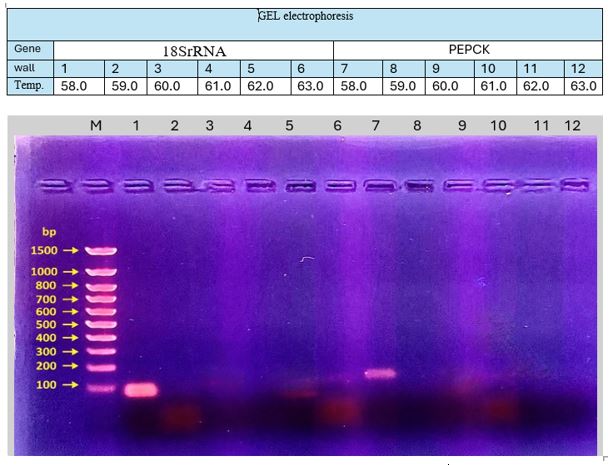
Phosphoenolpyruvate carboxykinase (PEPCK) is a key enzyme in gluconeogenesis, playing a vital role in metabolic adjustments during environmental stress. The results indicate that the PEPCK gene is responsive to salinity changes in Metapenaeus affinis, as the qPCR assays demonstrated successful and reliable amplification, confirming the quality of the generated data. Shrimp collected from the low-salinity environment exhibited the highest gene expression levels, particularly in the hepatopancreas, which showed the lowest ΔCt value 4.41 and the highest relative expression level (fold change = 8.53). In contrast, increasing salinity resulted in higher ΔCt values and a marked reduction in gene expression, with this decrease being statistically significant in the hepatopancreas, whereas the reduction observed in the gills was not statistically significant. Furthermore, gene expression in the hepatopancreas was significantly higher than that in the gills under low-salinity conditions, while no significant differences between the two tissues were detected under high-salinity conditions. Overall, given that osmoregulation is a complex physiological process involving multiple regulatory pathways and genes, these findings demonstrate that the PEPCK gene is affected by salinity changes. Consequently, these expression patterns suggest that the PEPCK gene can be considered a reliable biomarker for monitoring physiological and ecological conditions in M. affinis, particularly in the hepatopancreas.
References
Bustin, S. A.; Benes, V.; Garson, J. A.; Hellemans, J.; Huggett, J.; Kubista, M.; Mueller, R.; Nolan, T.; Pfaffl, M. W.; Shipley, G. L.; Vandesompele, J.; and Wittwer, C. T. (2009). The MIQE guidelines: Minimum information for publication of quantitative real-time PCR experiments. Clin. Chem., 55(4): 611–622. https://doi.org/10.1373/clinchem.2008.112797
Chen, K.; Li, E.; Li, T.; Xu, C.; Wang, X.; Lin, H.; et al. (2015). Transcriptome and molecular pathway analysis of the hepatopancreas in the Pacific white shrimp Litopenaeus vannamei under chronic low-salinity stress. PLoS One, 10(7), e0131503. https://doi.org/10.1371/journal.pone.0131503
Chen, Y. P.; Hu, C. C.; Tsai, S.; Wen, Z. H.; and Lin, C. (2025). Identification of housekeeping gene for future studies exploring effects of cryopreservation on gene expression in shrimp. Sci. Rep., 15(1), 11046. https://doi.org/10.1038/s41598-025-95258-6
Dall, W. H. B. J.; Hill, J.; Rothlisberg, P. C.; Sharples, D. J.; Blaxter, J. H.; and Southward, A. J. (1990). Advances in marine biology (Vol. 27). Academic Press. https://doi.org/10.1016/S0065-2881(08)60170-4
Dieffenbach, C. W.; Lowe, T. M. J.; and Dveksler, G. S. (1993). General concepts for PCR primer design. PCR Methods Appl., 3(3): S30–S37. https://doi.org/10.1101/gr.3.3.s30
FAO. (2022). The State of World Fisheries and Aquaculture 2022 (SOFIA). Food and Agriculture Organization of the United Nations, Rome. https://doi.org/10.4060/ca9229en
Forootan, A.; Sjöback, R.; Björkman, J.; Sjögreen, B.; Linz, L.; and Kubista, M. (2017). Methods to determine limit of detection and limit of quantification in quantitative real-time PCR (qPCR). Biomol. Detect. Quantif., 12: 1–6. https://doi.org/10.1016/j.bdq.2017.04.001
Freire, C. A.; Onken, H.; and McNamara, J. C. (2008). A structure–function analysis of ion transport in crustacean gills and excretory organs. Comp. Biochem. Physiol. A Mol. Integr. Physiol., 151(3): 272–304. https://doi.org/10.1016/j.cbpa.2007.05.008
Gutiérrez, J. C.; Ponce-Palafox, J. T.; Pineda-Jaimes, N. B.; Arenas-Fuentes, V.; Arredondo-Figueroa, J. L.; and Cifuentes-Lemus, J. L. (2016). The feeding ecology of penaeid shrimp in tropical lagoon-estuarine systems / Ecología alimentaria de camarones peneidos en los sistemas lagunar-estuarinos tropicales. Gayana, 80(1), 16–28. https://doi.org/10.4067/S0717-65382016000100003
Henry, R. P. (2001). Environmentally mediated carbonic anhydrase induction in the gills of euryhaline crustaceans. J. Exp. Biol., 204(5): 991–1002. https://doi.org/10.1242/jeb.204.5.991
Hu, Y.; Fu, H.; Qiao, H.; Sun, S.; Zhang, W.; Jin, S.; et al. (2018). Validation and evaluation of reference genes for quantitative real-time PCR in Macrobrachium nipponense. Int. J. Mol. Sci., 19(8), 2258. https://doi.org/10.3390/ijms19082258
Josileen, J.; and Pillai, N. G. K. (2013). Studies on penaeid shrimp resources and fisheries of India. J. Mar. Biol. Assoc. India, 55(2), 78–93. https://eprints.cmfri.org.in/9645/1/Manual_Taxonomy_Identification.pdf
Li, E.; Xu, C.; Wang, X.; Wang, S.; Zhao, Q.; Zhang, M.; and Qin, J. G. (2014). Gut microbiota and its modulation for healthy farming of Pacific white shrimp Litopenaeus vannamei. Rev. Fish. Sci. Aquac., 22(4), 307–319. https://doi.org/10.1080/23308249.2014.904257
Li, Y.; Zhang, Z.; Wang, Z.; Deng, Z.; Zhao, R.; Sun, J.; ... and Cui, Y. (2022). How do gene expression patterns change in response to osmotic stresses in kuruma shrimp (Marsupenaeus japonicus). J. Mar. Sci. Eng., 10(12), 1870. https://doi.org/10.3390/jmse10121870
Liu, H.; Wang, X.; Liu, Z.; Li, S. and Hou, Z. (2025). Osmoregulatory evolution of gills promoted salinity adaptation following the sea–land transition of crustaceans. Mar. Life Sci. Technol., 7(2), 205–217. https://doi.org/10.1007/s42995-025-00298-6
Livak, K. J.; and Schmittgen, T. D. (2001). Analysis of relative gene expression data using real-time quantitative PCR and the 2−ΔΔCT method. Methods, 25(4), 402–408. https://doi.org/10.1006/meth.2001.1262
López-López, S.; Nolasco-Soria, H.; Villarreal-Colmenares, H.; and Cuzon, G. (2024). Changes of glycolysis and gluconeogenesis key enzymes in the muscle of the shrimp Penaeus vannamei in response to hypoxia and reoxygenation. J. Exp. Mar. Biol. Ecol., 580, 152052. https://doi.org/10.1016/j.jembe.2024.152052
Mohamed, A. R. M.; Hassan, K. A.; and Abed, J. M. (2025). Fishery, Growth and Reproductive Biology of Metapenaeus affinis (Decapoda, Penaeidae) in the Iraqi waters. Int. J. Environ. Eng. Dev., 3, 100–110. https://doi.org/10.37394/232033.2025.3.8
Nelson, D. L.; and Cox, M. M. (2021). Lehninger principles of biochemistry (8th ed.). W. H. Freeman and Company.
Rahi, M. L.; Azad, K. N.; Tabassum, M.; Irin, H. H.; Hossain, K. S.; Aziz, D.; et al. (2021). Effects of salinity on physiological, biochemical and gene expression parameters of black tiger shrimp (Penaeus monodon): Potential for farming in low-salinity environments. Biology, 10(12), 1220. https://doi.org/10.3390/biology10121220.
Rosas, C.; Cuzon, G.; Gaxiola, G.; Pascual, C.; Taboada, G.; Arena, L.; and van Wormhoudt, A. (2002). An energetic and conceptual model of the physiological role of dietary carbohydrates and salinity on Litopenaeus vannamei juveniles. J. Exp. Mar. Biol. Ecol., 268(1), 47–67. https://doi.org/10.1016/S0022-0981(01)00368-2
Salman, S. D.; Ali, M. H.; and Al-Adhub, A. H. (1990). Abundance and seasonal migrations of the penaeid shrimp Metapenaeus affinis (H. Milne-Edwards) within Iraqi waters. Hydrobiologia, 196(1), 79–90. https://doi.org/10.1007/BF00008895
Schein, V.; Waché, Y.; Etges, R.; Kucharski, L. C.; van Wormhoudt, A.; and Da Silva, R. S. (2004). Effect of hyperosmotic shock on phosphoenolpyruvate carboxykinase gene expression and gluconeogenic activity in the crab muscle. FEBS Lett., 561(1–3), 202–206. https://doi.org/10.1016/S0014-5793(04)00162-0.
Thabet, R.; Ayadi, H.; Koken, M.; and Leignel, V. (2017). Homeostatic responses of crustaceans to salinity changes. Hydrobiologia, 799(1), 1–20. https://doi.org/10.1007/s10750-017-3232-1
Towle, D. W.; and Weihrauch, D. (2001). Osmoregulation by gills of euryhaline crabs: molecular analysis of transporters. Am. Zool., 41(4), 770–780. https://doi.org/10.1093/icb/41.4.770
Wang, W.; Huang, J.; Fang, W.; Zhang, H.; Chen, Z.; and Lu, J. (2024). Transcriptome analysis uncovers the expression of genes associated with growth in the gills and muscles of white shrimp (Litopenaeus vannamei) with different growth rates. Comp. Biochem. Physiol. D Genomics Proteomics, 52, 101347. https://doi.org/10.1016/j.cbd.2024.101347.
Downloads
Published
How to Cite
Issue
Section
License
Copyright (c) 2026 Iraqi Journal of Aquaculture

This work is licensed under a Creative Commons Attribution 4.0 International License.