Effect of bioaccumulation of lead, cadmium, and copper on the protein and lipid content of Metapenaeus affinis shrimp muscles in Shatt al-Basra Canal, Iraq
Keywords:
Bioaccumulation; Heavy metals; Metapenaeus affinis; Bioindicator; Shatt Al-Basrah Canal.Abstract
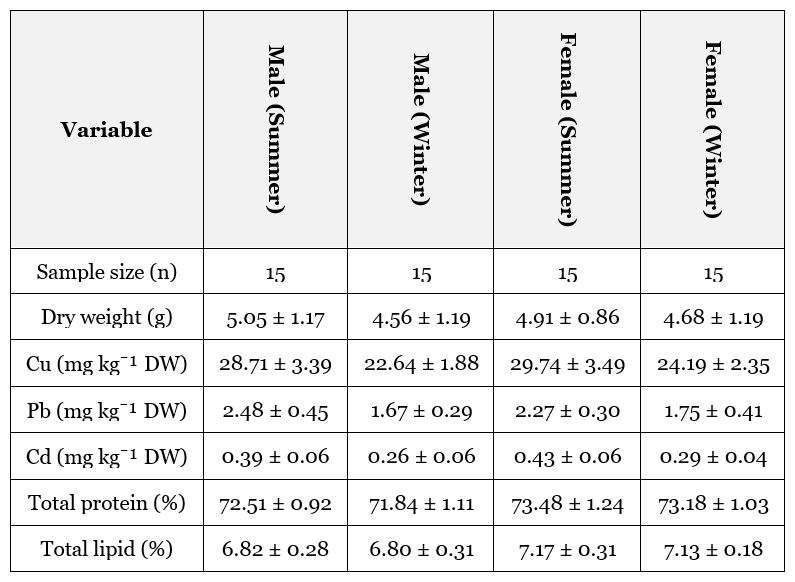
Heavy metal pollution in aquatic environments presents a substantial danger to environmental quality and seafood safety due to the bioaccumulation of trace metals in edible aquatic creatures. Monitoring of commercially important shrimp species provides useful data for the evaluation of metal contamination and its possible effect on human health. There is little information about seasonal and sexual changes of heavy metals bioaccumulation and biochemical composition of the muscle of Metapenaeus affinis from southern Iraq. This research analyzed the influence of season and sex on the accumulation of copper (Cu), lead (Pb) and cadmium (Cd) in the abdominal muscle and their relationship with protein and lipid levels in muscle. The season was the dominant factor in the accumulation of heavy metals in M. affinis, and sex was the dominant factor in the biochemical composition of the muscle. Concentrations of heavy metals were significantly higher in summer than in winter (p < 0.001), and females showed significantly higher muscle protein and lipid contents than males. The strong positive correlations between Cu, Pb and Cd suggest common environmental sources of contamination. Copper concentrations increased from 23.41 ± 2.21 to 28.75 ± 3.39 mg kg⁻¹ DW, lead from 1.71 ± 0.20 to 2.37 ± 0.32 mg kg⁻¹ DW, and cadmium from 0.280 ± 0.024 to 0.411 ± 0.029 mg kg⁻¹ DW from winter to summer. Females showed significantly higher total protein (73.27 ± 1.08%) and lipid (7.21 ± 0.26%) contents than males (72.17 ± 1.05% and 6.81 ± 0.29%, respectively). Pearson’s correlation analysis revealed the strongest association between Cu and Cd (r = 0.637, p < 0.001), whereas only weak positive correlations were observed between heavy metals and muscle protein content. Seasonal environmental conditions strongly regulate heavy metal bioaccumulation in M. affinis, whereas the muscle biochemical composition is mainly influenced by physiological processes related to sex. The species is a good bio-indicator for heavy metals pollution and a good source of baseline information for environmental monitoring and seafood safety assessment in Shatt Al-Basrah Canal, Southern Iraq.
Metrics
References
Abdul-Sahib,I.M. and Ajeel,S.G. (2005). Biochemical constituents and nutritional values for the males and females of the commercial penaeid shrimp Metapenaeus affinis (H. Milne -Edwards). J. Basrah Res. (Sci.) 31 (1): 35 – 40.
Abdul-Razak M. Mohamed, Khelud A. Hassan, and Jassim M. Abed. (2025). Fishery, Growth and Reproductive Biology of Metapenaeus affinis (Decapoda, Penaeidae) in the Iraqi waters. Int. J. Environ. Eng. Dev. 3:100-110. https://doi.org/10.37394/232033.2025.3.8
Ahearn, G. A., Mandal, P. K., and Mandal, A. (2004). Mechanisms of heavy-metal sequestration and detoxification in crustaceans: A review. J. Comp. Physiol. B. 174(6):439-52. https://doi.org/10.1007/s00360-004-0438-0
Alhumaidan, Z.A., Mohanad H. Al-Jaberi, and Wala′a Majeed Al-Mosawi. (2023). Assessment the Subbottom Sedimentary Situation for Khor Abdullah, NW Arabian Gulf Using Sedimentary Coring Analysis and Sub-Bottom Profile Technique , Iraqi Geol. J. Vol. 56(2D),150-166. DOI: https://doi.org/10.46717/igj.56.2D.12ms-2023-10-18
Al-Hemidawi, F. N., Hameed, A., and Al-Saad, H. T. (2020). Heavy metals concentrations in sediments of Al-Delmaj Marsh, Al-Qadisiya/Wasit Governorates, Southern Iraq. Al-Qadisiyah J. Pure Sci. 25(2), Envi. 5–12. https://doi.org/10.29350/2411-3514.1205.
Al-Janabi, Z., Zaki, S., AlHassany, J., Al-Obaidy, A. H. M., Awad, E., and Maktoof, A. (2019). Geochemical evaluation of heavy metals (Cd, Cr, Fe, and Mn) in sediment of Shatt Al-Basrah, Iraq. Eng. Technol. J. 37(2C), 237–241. https://doi.org/10.30684/etj.37.2C.6
Ali, H., Khan, E., and Ilahi, I. (2019). Environmental chemistry and ecotoxicology of hazardous heavy metals: Environmental persistence, toxicity, and bioaccumulation. J. Chem. Article 6730305. https://doi.org/10.1155/2019/6730305
Al-Maliky, T. H. Y., Al-Noor, S. S., and Ali, M. H. (2019). Effect of different temperatures on food consumption of juvenile’s shrimp Metapenaeus affinis (H. Milne Edwards, 1837). Arthropods, 8(1), 32–37. http://www.iaees.org/publications/journals/arthropods/rss.xml
Al-Maliky, T., Hashim, M., Shakir, Z., and Jabbar, I. (2025). A study of some of the biology of the Metapenaeus affinis in the waters of the North Western Arabian Gulf. GPH-Int. J. Agric. Res. 8(8), 29-32. https://doi.org/10.5281/zenodo.17405897
Al-Najar, G. A., Yesser, A. T., Jabir, A. A., and Younis, K. H. (2023). Short-term assessment of heavy metals in surface waters of the Shatt Al-Arab River. Int. J. Aquat. Biol. 11(1), 34–40. https://doi.org/10.22034/ijab.v11i1.1784
Amiard, J. C., Amiard-Triquet, C., Barka, S., Pellerin, J., and Rainbow, P. S. (2006). Metallothioneins in aquatic invertebrates: Their role in metal detoxification and their use as biomarkers. Aquat. Toxicol. 76(2), 160–202. https://doi.org/10.1016/j.aquatox.2005.08.015
Alloway, B. J. (2013). Heavy metals in soils: Trace metals and metalloids in soils and their bioavailability (3rd ed.). Springer. https://doi.org/10.1007/978-94-007-4470-7
AOAC Association of Official Analytical Chemists. (2019). Official Methods of Analysis. https://www.aoac.org/official-methods-of-analysis/
Al-Asadi, S. A. R., Al-Qurnawi, W. S., Al Hawash, A. B., Ghalib, H. B., and Alkhlifa, N. A. A. (2020). Water quality and impacting factors on heavy metals levels in Shatt Al-Arab River, Basra, Iraq. Appl. Water Sci. 10, 103. https://doi.org/10.1007/s13201-020-01196-1
Al-Silawy, Z. H.; Al-Abbawy, D. A.; and Al-Mahmood, H. K. H. (2025). Assessment of Seasonal and Spatial Variation of Heavy Metals Concentrations in Shatt Al-Arab River, Basrah, Iraq. Environment Asia, 2025, Vol 18, Issue 2, p131, doi. 10.14456/ea.2025.43.
Ariano, A., Scivicco, M., D’Ambola, M., Velotto, S., Andreini, R., Bertini, S., Zaccaroni, A., and Severino, L. (2021). Heavy Metals in the Muscle and Hepatopancreas of Red Swamp Crayfish (Procambarus clarkii) in Campania (Italy). Animals, 11(7), 1933. https://doi.org/10.3390/ani11071933
Arisekar,U.; Shakila, R.J.; Shalini,R.; Jeyasekaran,G.; Padmavathy,P.; Sri Hari,M. and Sudhan,C. (2022). Accumulation potential of heavy metals at different growth stages of Penaeus vannamei farmed along the southeast coast of Peninsular India: A report on ecotoxicology and human health risk assessment. Environ. Res. 212, 113105 https://doi.org/10.1016/j.envres.2022.113105
Asare, D., Mpwaga, A. Y., Zheng, Y., Li, G., Tan, B., and Zhang, S. (2025). Understanding the Detrimental Effects of Heavy Metal Pollution in Shrimp Farming and Treatment Methods - A Review. Ann. Anim. Sci. 25(1): 35-56. https://reference-global.com/article/10.2478/aoas-2024-0041
Altofan, M. A., Al-Taee, A. M., and Akbar, M. M. (2023). Effect of some heavy metals on the biochemical parameters of the freshwater shrimp, Macrobrachium nipponense (De Haan, 1849). Int. J. Aquat. Biol. 11(3), 252–261. https://doi.org/10.22034/ijab.v11i3.2015
Aziz, K. H. H., Mustafa, F. S., Omer, K. M., Hama, S., Hamarawf, R. F., and Rahman, K. O. (2023). Heavy metal pollution in the aquatic environment: Efficient and low-cost removal approaches to eliminate their toxicity: A review. RSC Advances, 13, 17595–17610. https://doi.org/10.1039/D3RA00723E
Banaee, M., Zeidi, A., Mikušková, N., and Faggio, C. (2024). Assessing metal toxicity on crustaceans in aquatic ecosystems: A comprehensive review. Biol. Trace Elem. Res., 202(12), 5743–5761. https://doi.org/10.1007/s12011-024-04122-7
Biswas,C.; , Soma,S.S; Md, F. R.; Md, H. R.; Abul Bashar,and Md. S.H. (2021). Assessment of heavy metals in farmed shrimp, Penaeus monodon sampled from Khulna, Bangladesh: An inimical to food safety aspects, Heliyon.7:3, e06587, https://doi.org/10.1016/j.heliyon.2021.e06587
Briffa, J., Sinagra, E., and Blundell, R. (2020). Heavy metal pollution in the environment and their toxicological effects on humans. Heliyon, 6(9), e04691. https://doi.org/10.1016/j.heliyon.2020.e04691
Canli, M., and Atli, G. (2003). The relationships between heavy metal concentrations and the size of six Mediterranean fish species. Environ. Pollut., 121(1), 129–136. https://doi.org/10.1016/S0269-7491(02)00194-X
Comber, S., Deviller, G., Wilson, I., Peters, A., Merrington, G., Borrelli, P. and Baken, S. (2023), Sources of copper into the European aquatic environment. Integr. Environ. Assess. Manag., 19: 1031-1047. https://doi.org/10.1002/ieam.4700
Dietrich M, and Ayers J. (2021). Geochemical partitioning and possible heavy metal(loid) bioaccumulation within aquaculture shrimp ponds. Sci. Total Environ. 20; 788:147777. https://doi.org/10.1016/j.scitotenv.2021.147777
Farag, M. A., Mansour, S. T., Nouh, R. A., and Khattab, A. R. (2023). Crustaceans (shrimp, crab, and lobster): A comprehensive review of their potential health hazards and detection methods to assure their biosafety. J. Food Saf., 43(1), e13026. https://doi.org/10.1111/jfs.13026
Food and Agriculture Organization (FAO), and World Health Organization (WHO). (2011). Joint FAO/WHO food standards programme: Codex Alimentarius Commission. https://www.fao.org/fao-who-codexalimentarius
Food and Agriculture Organization (FAO). (2024). FAO Species Fact Sheets: Metapenaeus affinis. https://www.fao.org/fishery/en
Gray BCT, Champion C, Broadhurst MK, Coleman MA, Benkendorff K. (2025). Effects of contaminants and flooding on the physiology of harvested estuarine decapod crustaceans: A global review and meta-analysis. Environ Pollut. 1;364(Pt 2):125347. doi: 10.1016/j.envpol.
Hamzah, S. A.-A. (2024). Spatial analysis of heavy metal concentrations in the waters of Shatt Al-Basra Canal, Iraq. Uruk J. Human Sci., 16(2), Article 47. https://muthuruk.mu.edu.iq/journal/vol16/iss2/47
Hassan, K. A.; Abdul-Raza, M.M. and Jassim, M.A. (2024). Growth, mortality and stock assessment of Metapenaeus affinis (Decapoda, Penaeidae) from Iraqi waters. J. Appl. Nat. Sci., 16(4), 1552 - 1563. https://doi.org/10.31018/jans.v16i4.5910
Jaishankar, M., Mathew, B. B., Shah, M. S., and KR, S. G. (2014). Biosorption of Few Heavy Metal Ions Using Agricultural Wastes. J. Environ. Pollut. Human Health, 2(1), 1-6. doi: 10.12691/jephh-2-1-1
Järup, L. (2003). Hazards of heavy metal contamination. Br. Med. Bull., 68(1), 167–182. https://doi.org/10.1093/bmb/ldg032
Jeong, H., Byeon, E., Kim, D.-H., Maszczyk, P., and Lee, J.-S. (2023). Heavy metals and metalloid in aquatic invertebrates: A review of single/mixed forms, combination with other pollutants, and environmental factors. Mar. Pollut. Bull., 191, 114959. https://doi.org/10.1016/j.marpolbul.2023.114959
Jin Y, Luo J, Lu Z, Du J, Wang Y, Tian Z, Xu W, He Z and Dou C. (2026). Comprehensive assessment and source apportionment of heavy metals in a typical estuarine-bay system: a case study of Guanghai Bay, South China Sea. Front. Mar. Sci. 12:1722611. https://doi.org/10.3389/fmars.2025.1722611
Kanani, K. H., Resen, A. K., and Hassan, S. S. (2025). Evaluation of organic pollution in Shatt Al-Basrah Canal, Southern Iraq. Iran. J. Aquat. Biol., 13(5). https://doi.org/10.22034/ijab.v13i5.2396
Keshavarzifad, M., Vazirzadeh, A. and Sharifinia, M. (2021). Occurrence and Characterization of Microplastics in White Shrimp, Metapenaeus affinis, Living in a Habitat Highly Affected by Anthropogenic Pressures, Northwest Persian Gulf. Mar. Pollut. Bull., 169, Article ID: 112581. https://doi.org/10.1016/j.marpolbul.2021.112581
Kumar M, Singh S, Jain A, Yadav S, Dubey A, Trivedi SP. (2024). A review on heavy metal-induced toxicity in fishes: Bioaccumulation, antioxidant defense system, histopathological manifestations, and transcriptional profiling of genes. J. Trace Elem. Med. Biol. 83:127377. https://doi.org/10.1016/j.jtemb.2023.127377
Liang X, Luo X, Lin H, Han F, Qin JG, Chen L, Xu C and Li E (2022) Effects and Mechanism of Different Phospholipid Diets on Ovary Development in Female Broodstock Pacific White Shrimp, Litopenaeus vannamei. Front. Nutr. 9:830934. doi: 10.3389/fnut.2022.830934
Liang, H.; Wang, G.; Guo, H.; Niu, L. and Yang Q. (2025). Evaluation of heavy metal accumulation and sources in surface sediments of the Pearl River Estuary (China). Mar. Enviro. Res. https://doi.org/10.1016/j.marenvres.2025.106948
Liu, Q.; Jia, Z.; Liu, G.; Li,S. and Hu,J. (2023).Assessment of heavy metals remobilization and release risks at the sediment-water interface in estuarine environment. Mar. Pollut. Bull. 187, 114517. https://doi.org/10.1016/j.marpolbul.2022.114517
Mahmudiono, T., Mansur Khalaf Al-Khazaleh, J., Mohammadi, H., Daraei, H., Javid, A., Sarafraz, M., Heidarinejad, Z.; Fakhri,Y.; Atamaleki,A. and Mousavi Khaneghah, A. (2024). The concentration of Potentially Toxic elements (PTEs) in the muscle of crabs: a global systematic review, meta-analysis, and health risk assessment. Int. J. Environ. Health Res., 34(4), 2140–2166. https://doi.org/10.1080/09603123.2023.2218294
Ramos-Miras, J.; Sanchez-Muros, M.J.; Renteria, P; de Carrasco, C.G.; Roca-Perez, L.; Navarro,M.B.; Pro,J. and Martín,J.A.R. (2023). Potentially toxic element bioaccumulation in consumed indoor shrimp farming associated with diet, water and sediment levels. Environ. Sci. Pollut Res. 30, 121794–121806. https://doi.org/10.1007/s11356-023-30939-1
Rainbow, P. S. (2002). Trace metal concentrations in aquatic invertebrates: Why and so what? Environ. Pollut., 120(3), 497–507. https://doi.org/10.1016/S0269-7491(02)00238-5
Rainbow, P. S. (2007). Trace metal bioaccumulation: Models, metabolic availability and toxicity. Environ. Int. 33(4), 576–582. https://doi.org/10.1016/j.envint.2006.05.007
Ra, W.J, Yoo, H.J, Kim, Y.H, Yun, T, Soh, B, Cho. S.Y, Joo, Y, and Lee, K.W. (2023). Heavy metal concentration according to shrimp species and organ specificity: Monitoring and human risk assessment. Mar. Pollut. Bull. 197:115761. https://doi.org/10.1016/j.marpolbul.2023.115761
Smriti, Ahmed, A., Lodhi, S., and Shukla, S. (2023). Copper toxicity in aquatic ecosystem: A review. Int. J. Fish. Aquat. Stud. 11(4), 134–138. https://doi.org/10.22271/fish.2023.v11.i4b.2835)
Taslima,K.; Al-Emran,M.; Rahman,M.S.; Hasan,J.; Ferdous,Z.; Rohani,M.F. and Shahjahan, M.(2022). Impacts of heavy metals on early development, growth and reproduction of fish – A review. Toxicol. Rep. 9, 858-868. https://doi.org/10.1016/j.toxrep.2022.04.013
Tchounwou, P. B., Yedjou, C. G., Patlolla, A. K., and Sutton, D. J. (2012). Heavy metal toxicity and the environment. EXS, 101, 133–164. https://doi.org/10.1007/978-3-7643-8340-4_6
United Nations Environment Programme (UNEP). (2019). Global Environment Outlook 6 (GEO-6): Healthy Planet, Healthy People. https://www.unep.org/resources/global-environment-outlook-6
United Nations Environment Programme (UNEP). (2021). Making Peace with Nature: A Scientific Blueprint to Tackle the Climate, Biodiversity and Pollution Emergencies.
World Bank. (2023). Iraq Country Climate and Development Report.
Van Dijk, D. and Houba, V.J.G. (2000). Homogeneity and Stability of Material distributed within the Wageningen Evaluating Programmes for Analytical Laboratories Commun. Soil.Sci.Plant.Anal, 31 (11-14), 1745-1756
Wang, W. X., and Fisher, N. S. (1999). Delineating metal accumulation pathways for marine invertebrates. Sci. Total Environ., 237–238, 459–472. https://doi.org/10.1016/S0048-9697(99)00158-8
Waqas, W., Yuan, Y., Ali, S., Zhang, M., Shafiq, M., Ali, W., Chen, Y., Xiang, Z., Chen, R., Ikhwanuddin, M., and Ma, H. (2024). Toxic effects of heavy metals on crustaceans and associated health risks in humans: A review. Environ. Chem. Lett., 22(3), 1391–1411. https://doi.org/10.1007/s10311-024-01717-3
Wang, X., Zhong, L., Zhang, H., Li, D., Xu, K., and Zhou, Y. (2022). Dissolved metal assessment in surface seawater: A spatial-seasonal evaluation in the Zhejiang coastal waters, the East China Sea. Mar. Pollut. Bull., 185, 114226. https://doi.org/10.1016/j.marpolbul.2022.114226
World Health Organization (WHO). (2022). Guidelines for drinking-water quality (4th ed., incorporating the second addendum). https://www.who.int/publications/i/item/9789240045064
Waqas W., Yongcheng X., Ye Y., Mhd I., and Hongyu M. (2026). Heavy metals bioaccumulation and its impact on fatty acids composition in the benthic crustacean mud crab (Scylla paramamosain) and associated human health risk, Mar. Pollut. Bull., 227,119454. https://doi.org/10.1016/j.marpolbul.2026.119454.
Yang, R., Roshani, D., Gao, B., Li, P., and Shang, N. (2024). Metallothionein: A Comprehensive Review of Its Classification, Structure, Biological Functions, and Applications. Antioxidants, 13(7), 825. https://doi.org/10.3390/antiox13070825
Zhang, L.; Shi, Z.; Jiang, Z.; Zhang, J.; Wang, F. and Huang, X. (2015). Distribution and bioaccumulation of heavy metals in marine organisms in east and west Guangdong coastal regions, south China. Mar. pollut. Bull. 101, 930–937. https://doi.org/10.1016/j.marpolbul.2015.10.041
Downloads
Published
How to Cite
Issue
Section
License
Copyright (c) 2026 Iraqi Journal of Aquaculture

This work is licensed under a Creative Commons Attribution 4.0 International License.