Effects of Long-Term Frozen Storage on Fat-Soluble Vitamin Content in the Muscle of Common Carp (Cyprinus carpio L.)
Keywords:
Cyprinus carpio, Fat-soluble vitamins, High-performance liquid chromatography, Frozen storage, Vitamin degradation kinetics.Abstract
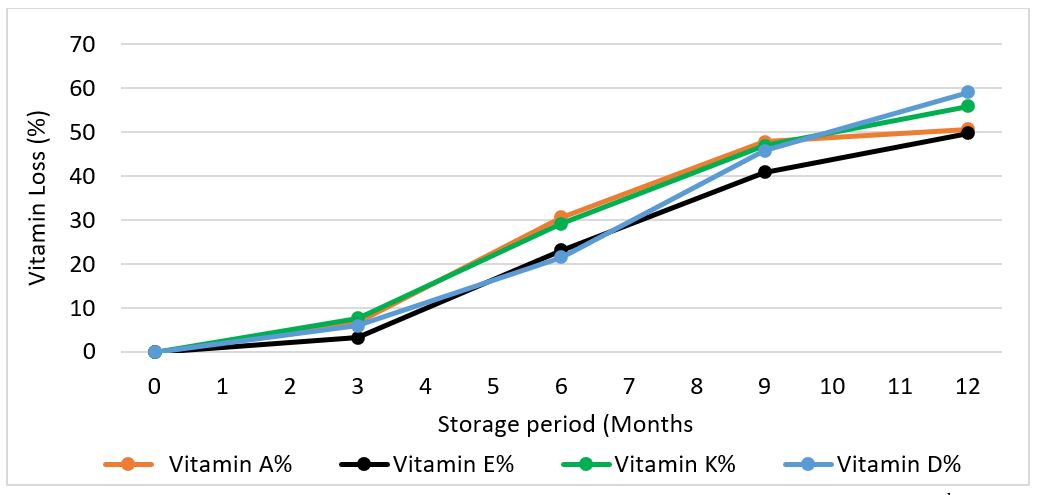
In this study, the stability of fat-soluble vitamins (A, D, E, and K) in common carp (Cyprinus carpio L.) during frozen storage at −18°C for up to 12 months was investigated. It was found that HPLC analysis showed that there is a statistically significant decrease (p ≤ 0.05) of the vitamins' concentration with time. The highest level of loss was shown by vitamin D (59.1%) and vitamin K (55.9%), while vitamin A and vitamin E loss were 50.7% and 49.8%, respectively. This progressive decline of the vitamin's concentration suggests that a considerable decrease in its nutritional value occurs with prolonged frozen storage. This work contributes to the knowledge about the chemical stability of vitamins in fish muscle and provides important information concerning their quality for both aquaculture and the food industry. The presented data show that nutrition value is considerably reduced after six months of frozen storage.
Metrics
References
Abeywardana, L.; Gamage, T.V.; Singh, T.K.; Zhao, S.; Logan, A. and Kong, L. (2026). Degradation Mechanisms, Encapsulation- Based Stabilization, and Analytical Detection of Vitamin A. J. Am. Oil Chemi. Soc., 0:1–19. https://aocs.onlinelibrary.wiley.com/doi/pdf/10.1002/aocs.70119?utm_source=copilot.com.
Ali, A.; Wei, S.; Ali, A.; Khan, I.; Sun, Q.; Xia, Q.; Wang, Z.; Han, Z.; Liu, Y. and Liu, S. (2022). Research progress on nutritional value, preservation and processing of fish. Foods, 11(22), 3669. https://doi.org/10.3390/foods11223669.
Andrès, E.; Lorenzo-Villalba, N.; Terrade, J.-H. and Méndez-Bailon, M. (2024). Fat-Soluble Vitamins A, D, E, and K: Review of the Literature and Points of Interest for the Clinician, J. Clin. Med., 13(13), 3641. https://doi.org/10.3390/jcm13133641.
Azeem, R.; Aslam, M.; Mehmood, T. and Al‑Essa, L.A. (2025). Predicting extreme thermal degradation of ascorbic acid (Vitamin C) using Bayesian‑Inverse Weibull models: Applications in stability analysis and process optimization. Plops One, 20(12), e0328554.https://journals.plos.org/plosone/article?id=10.1371/journal.pone. 0328554.
Cheng, K.; Huang, Y.; Wang, C.; Ali, W. and Karrow, N. (2023). Physiological function of vitamin D3 in fish. Reviews in Aquaculture. DOI: 10.1111/raq.12814.
Coad, J. and Bui, V. (2020). Stability of Vitamins B1, B2, B6 and E in a Fortified Military Freeze-Dried Meal During Extended Storage. Food Chemi., 9(1): 39; 320, 126–134. https://doi.org/10.3390/foods9010039 .
Dahl Lassen, R.; van Hecke, J. J. J.; Jørgensen, H.; Bukh, C.; Andersen, B. and Schjoerring, J. K. (2018). High throughput analysis of amino acids in plant materials by single quadrupole mass spectrometry. Plant Methods, 14(1), 8. https://doi.org/10.1186/s13007-018-0277-8.
Dobreva, D.; Stancheva, M. and Merdzhanova, A. (2013). Effect of Frozen Storage on Fat Soluble Vitamins Content in Fish Fillets. J. Food Compos. Anal., 31(2), 230–236.
Du, N.; Sun, Y.; Chen, Z.; Huang, X.; Li, C.; Gao, L.; Bai, S.; Wang, P. and Hao, Q. (2023). Effects of Multiple Freeze-Thaw Cycles on Protein and Lipid Oxidation, Microstructure and Quality Characteristics of Rainbow Trout (Oncorhynchus mykiss). Fishes, 8(2), 108; https://doi.org/10.3390/fishes8020108.
El- Sayed, A.-F.M. and Izquierdo, M. (2021). The importance of vitamin E for farmed fish—A review. Rev Aquac.; 00:1–16. https://www.scispace.com/pdf/the-importance-of-vitamin-e-for-farmed-fish-a-review-suur2802oz.pdf?utm_source=copilot.com.
(FAO). (2024). The State of World Fisheries and Aquaculture 2024. Food and Agriculture Organization of the United Nations.
Gimmel, A.; Baumgartner, K.; Bäckert, S.; Tschudin, A.; Lang, B.; Hein, A.; Marcordes, S.; Wyss, F.; Wenker, C. and Liesegang, A. (2022). Effects of Storage Time and Thawing Method on Selected Nutrients in Whole Fish for Zoo Animal Nutrition. Animals, 12(20), 2847; https://doi.org/10.3390/ani12202847.
Hassan, A.; Ahmed, I.; Reshi, Q.M. and Hassan, P. (2025). Role of Fat-Soluble Vitamins in Fish Nutrition. Aquaculture: Enhancing Food Security and Nutrition, 203–224PP, Springer.
Herrera-Ardila, Y.M.; Orrego, D.; Bejarano-López, A.F. and Klotz-Ceberio, B. (2022). Effect of heat treatment on vitamin content during the manufacture of food products at industrial scale. Rev. DYNA, 89(223), 127-132PP.
Hu, C., and Xie, J. (2021). The Effect of Multiple Freeze–Thaw Cycles on the Microstructure and Quality of Trachurus murphyi. Foods, 10(6): 1350. https://doi.org/10.3390/foods10061350.
Hu, Q.; Lyu, J.; Li, J.; Lin, X.; Li, S.; Bu, Y. and Zhao, Q. (2025). A comprehensive analysis of vitamin A deficiency burden and trends: Insights from the global burden of disease study 2021 and future predictions to 2050. Front. Nutr., 12, 1673576. https://doi.org/10.3389/fnut.2025.1673576.
ICH. (2023). ICH Q2(R2): Validation of analytical procedures. Geneva: ICH Secretariat.
Khan, M.U.; Hamid, K.; Tolstorebrov, I. and Eikevik, T.M. (2024). A comprehensive investigation of freeze concentration approaches for fish protein hydrolysates. Food Chem., 452, 139559. DOI: 10.1016/j.foodchem.2024.139559.
Knuth, M. M.; Stutts, W. L.; Ritter, M. M.; Garrard, K. P. and Kullman, S. W. (2021). Vitamin D deficiency promotes accumulation of bioactive lipids and increased endocannabinoid tone in zebrafish. J. Lipid Res., 62: 100142. https://doi.org/10.1016/j.jlr.2021.100142.
Ladole, M.R.; Nair, R.R.; Bhutada, Y.D.; Amritkar, V.D. and Pandit, A.B. (2018). Synergistic effect of ultrasonication and co-immobilized enzymes on tomato peels for lycopene extraction. Ultrasonics Sonochemistry, 48, 453-462PP.
Li, L.; Li, W.; Qu, Z.; Yang, W.; Liu, D. and Ni, B. (2025). Effects of different thawing methods on lipid oxidation and volatile organic compounds in salmon. Eur. Food Res. Technol., 251, 1127–1143PP. https://link.springer.com/article/10.1007/s00217-025-04693-2.
Li, X., Lv, H., Luo, W., Yang, W., Kong, L., Zhu, Q., and Zeng, L. (2025). Recent advances in detection techniques for vitamin analysis: A comprehensive review. Food Chemi.: X, 26, 102226. https://www.sciencedirect.com/science/article/pii/S2590157525000732.
Liu, R.X.; Tan, C.M., Tu, Z.C.; Nie, S.; Yu, Y.; Hu, J. and Zhang, L. (2025). Research progress on the mechanism of fish quality deterioration during frozen storage and novel control technologies. Food Scie. Animal Products, 3, 9240105. https://doi.org/10.26599/FSAP.2025.9240105 .
López-Puebla, S.; Arias-Santé, M.F.; Romero, J.; de Camargo, A.C. and Rincón-Cervera, M.A. (2025). Analysis of Fatty Acid Profile, α-Tocopherol, Squalene and Cholesterol Content in Edible Parts and By-Products of South Pacific Wild Fishes. Mar. Drugs, 23(3), 104; https://doi.org/10.3390/md23030104.
Ma, F.; Wang, L.; Huang, J.; Chen, Y.; Zhang, L.; Zhang, M.; Yu, M.; Jiang, H. and Qiao, Z. (2023). Comparative study on nutritional quality and serum biochemical indices of common carp (Cyprinus carpio) aged 11 to 13 months aged cultured in traditional ponds and land-based container aquaculture systems, Food Res. Int. 169(2): 112869. https://www. sciencedirect.com/science/article/abs/pii/S0963996923004143.
Rakuša, Z.T.; Pišlar, M.; Krist, A. and Roškar, R. (2021). Comprehensive Stability Study of Vitamin D3 in Aqueous Solutions and Liquid Commercial Products. Pharmaceutics, 13(5), 617; https://doi.org/10.3390/pharmaceutics13050617.
Sadler, R.A.; Shoveller, A.K.; Shandilya, U.K.; Charchoglyan, A.; Wagter-Lesperance, L.; Bridle, B.W.; Mallard, B.A. and Karrow, N.A. (2024). Beyond the Coagulation Cascade: Vitamin K and Its Multifaceted Impact on Human and Domesticated Animal Health. Curr. Issues Mol. Biol. 46, 7001–7031. https://doi.org/10.3390/cimb46070418.
Silva, N G.; Preto, M.; Vasconcelos, V. and Urbatzka, R. (2024). Reduction of neutral lipid reservoirs and distinct roles for vitamin K isoforms on lipid metabolism. Food Funct., 15: 2170–2180. https:// pubs. rsc.org/ en/content /articlelanding /2024/fo/ d3fo02915h#:~:text=Vitamin%20K%20isoforms%20are%20known%20as%20co-factors%20for,Tychonema%20sp.%20LEGE%2007196%20with%20lipid%20reducing% 20activity.
Wang, K.; Wang, E.; Qin, Z.; Zhou, Z.; Geng, Y. and Chen, D. (2016). Effects of dietary vitamin E deficiency on systematic pathological changes and oxidative stress in fish. Oncotarget,7(51):83869–83879. doi: 10.18632/oncotarget.13729.
Xie, G.; Cao, S.; Wang, G.; Zhang, X.; Zhang, Y.; Wu, H.; Shen, S.; Le, J.; Li, K. and Huang, Z. (2025). Vitamin A and its influence on tumour extracellular matrix, Discover Oncology, 16(16). | https://doi.org/10.1007/s12672-025-01751-9.
You, D.K.; Fuwad, A.; Lee, K.H.; Kim, H.K.; Kang, L.; Kim, S.M. and Jeon1, T.-J. (2024). Evaluation of the Protective Role of Vitamin E against ROS-Driven Lipid Oxidation in Model Cell Membranes. Antioxidants, 13, 1135. https://doi.org/10.3390/antiox13091135.
Żandarek, A.; Kowalska, M. and Nowak, J. (2023). Development and validation of HPLC methods for B vitamins in food matrices. J. Chromatogr. A, 11(3):937,1689, 463–472. https://doi.org/10.3390/pr11030937.
Downloads
Published
How to Cite
Issue
Section
License
Copyright (c) 2026 Iraqi Journal of Aquaculture

This work is licensed under a Creative Commons Attribution 4.0 International License.